

Key Takeaways
-
Choosing the wrong lever hoist capacity creates safety hazards and reduces efficiency. A hoist that is too light risks failure under load; one that is too heavy can be difficult to control. Always match capacity to the actual load weight.
-
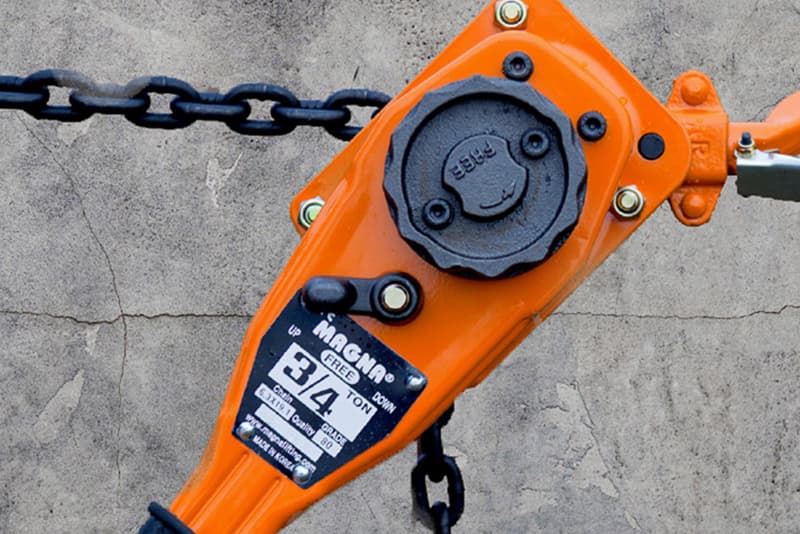
MAGNA lever hoists cover a range from 1/4 ton (500 lbs.) to 6+ tons (12,000+ lbs.), with each range suited to specific agricultural tasks.
-
Common agricultural applications include equipment maintenance and repair, livestock handling, grain and hay storage, and irrigation system installation.
-
MAGNA hoists are engineered in the United States and manufactured at an ISO 9001-certified facility in South Korea, with a design rated 18% more robust than major competitors.
-
Always consult manufacturer guidelines for the specific hoist model before use. Never exceed rated capacity.
A lever hoist that is undersized for the job can slip or fail under load. One that is oversized is harder to control and may not be the right tool for precision tasks like positioning livestock or aligning irrigation pipe. In agricultural settings, where loads range from a few hundred pounds of livestock to several tons of field machinery, selecting the right capacity lever hoist determines whether the job gets done safely or not.
MAGNA lever hoists are purpose-built for this range of demands. This guide covers how to match hoist capacity to common farm tasks, from equipment maintenance and animal handling to bulk material storage and irrigation work.
Which Lever Hoist Capacity Works Best for Equipment Maintenance?
Agricultural equipment maintenance regularly involves heavy components: engines, transmissions, large tires, and implements that cannot be safely moved by hand. A MAGNA lever hoist gives mechanics and farmers the lifting force and control needed to position components precisely during repair, reducing the risk of damage to parts and injury to workers.
How Do You Select the Right Lever Hoist Capacity?
When sizing a lever hoist for agricultural maintenance, three factors drive the decision: load weight, required lift height, and the nature of the task. Here are common capacity ranges and their typical applications:
-
1/4 to 1/2 ton (500 to 1,000 lbs.) - 1/4 ton and 1/2 ton hoists handle light components, small parts, and positioning tasks where control matters more than raw capacity.
-
1/2 to 1 ton (1,000 to 2,000 lbs.) - Mid-range capacity for lifting implements, mid-sized machinery, and farm equipment components. 1 ton hoist is the most common size for general farm shop work.
-
1 to 3 tons (2,000 to 6,000 lbs.) - Suitable for heavier maintenance work: pulling engines, lifting large implements, or repositioning major drivetrain components. The 3-ton hoist covers most heavy farm shop applications.
-
3 to 6 tons (6,000 to 12,000 lbs.) - For heavy-duty lifting: large vehicles, heavy machinery, or high-load positioning. See 6-ton hoist.
-
6 tons and above (12,000+ lbs.) - Required for the heaviest agricultural machinery and large-scale lifting operations where standard farm hoists are insufficient.
Always verify the actual load weight before selecting a hoist. Consult the manufacturer's guidelines and capacity ratings for the specific MAGNA model you plan to use.
How Are Lever Hoists Used in Livestock Handling?
There are situations in livestock operations where animals need to be lifted or repositioned: a downed animal, a medical procedure, or loading onto a transport vehicle. MAGNA lever hoists in the 1/4 to 1 ton range cover most livestock handling scenarios, with capacity selection driven by animal size and weight.
Smaller animals typically require a MAGNA 1/4-ton lever hoist. Larger animals such as cattle, horses, and large hogs may require a 1 ton or 2 ton hoist. The controlled lifting speed of a lever hoist reduces stress on the animal and the risk of injury to handlers.
Can Lever Hoists Handle Grain, Hay, and Bulk Agricultural Materials?
Yes. MAGNA lever hoists are practical tools for elevating heavy sacks of grain, bales of hay or straw, and other bulk agricultural products for storage. In barns and warehouses where vertical space needs to be used efficiently, a hoist lets workers lift and position loads that would otherwise require multiple people or powered equipment. Capacity selection follows the same load-weight principle as maintenance tasks.
How Do Lever Hoists Support Irrigation System Work?
Installing and maintaining farm irrigation systems requires positioning heavy pipe sections, valves, and fittings with precision. A lever hoist provides the controlled lifting force needed to place and align components without relying on multiple workers to hold position. This is especially useful when working in trenches or tight spaces where awkward angles make manual handling impractical.
Why Do Agricultural Operations Use MAGNA Lever Hoists?
-
Efficiency: MAGNA hoists reduce the manual effort required to move heavy loads, cutting task time and operator fatigue.
-
Safety: Load limiters and robust hooks prevent accidental slippage or dropping. Reducing manual lifting lowers the risk of musculoskeletal injuries to workers.
-
Versatility: Available in capacities from 1/4 ton to 6+ tons, with compact, portable designs suited to use in fields, shops, and barns.
-
Cost-effectiveness: A lever hoist delivers reliable lifting capability without the overhead of powered lifting equipment.
-
Build quality: MAGNA hoists are engineered in the United States and manufactured in South Korea at an ISO 9001-certified facility. The design is rated 18% more robust than those of major competitors. MAGNA products have performed in North American agricultural and industrial operations for over 20 years.
Need Help?
Contact us today or call us at 800-669-9650 for help selecting the right MAGNA lever hoist for your operation. We have 11 locations across the Southeast and Midwest, including Knoxville, TN; Marietta, GA; Orlando, FL; Charlotte, NC; Little Rock, AR; Fort Worth, TX; Benton, IL; Madisonville, KY; Princeton, WV; Birmingham, AL; and Calvert City, KY.
Frequently Asked Questions
Check the weight of the load against the hoist's rated capacity. The rated capacity is the maximum safe working load the hoist can handle. Never exceed it. If the load weight is uncertain, use a scale or manufacturer weight data for the equipment before selecting a hoist.
A lever hoist is manually operated using a ratcheting lever mechanism and is designed for portability and precise load positioning. A chain hoist (also called a chain block) typically uses a hand chain and is better suited to sustained vertical lifting from a fixed point. Lever hoists are more practical for mobile agricultural applications where the hoist needs to travel between job sites.
MAGNA lever hoists are built for industrial use, which includes outdoor agricultural settings. That said, protect hoists from prolonged exposure to moisture, mud, and corrosive materials when not in use. Follow the manufacturer's maintenance schedule and inspect the hook, chain, and load limiter before each use.
MAGNA hoists include load limiters that prevent overloading, robust forged hooks designed to resist deformation under load, and a ratcheting mechanism that holds position without slipping. These features reduce the risk of dropped loads, which is critical when working around livestock or personnel.
Royal Brass & Hose carries MAGNA lever hoists across the full capacity range, from 1/4 ton through 6 ton and above, along with rigging and lifting accessories. If you need help matching hoist capacity to a specific agricultural task, our team can help you spec the right tool before you order.


