


Key Takeaways
-
A failing air conditioning (AC) high-pressure hose shows three warning signs: physical damage, refrigerant leaks, and loss of cooling.
-
Physical damage from heat, friction, and abrasion is often the earliest visible sign of hose failure.
-
Even a small refrigerant leak will drain the AC system quickly, leaving it unable to produce cold air.
-
If the AC stops cooling entirely, inspect the high-pressure hose before condemning the compressor or other components.
-
A damaged or leaking AC high-pressure hose should be replaced promptly to prevent further system damage.
When an air conditioning (AC) system stops working in summer heat, a failed high-pressure hose is one of the most common causes. The AC high-pressure hose carries refrigerant from the compressor outlet to the receiver/drier under significant pressure, typically 150 to 300 psi depending on ambient temperature and engine load. The hose runs through the engine bay, where it faces constant heat, vibration, and contact with nearby components. Those conditions make it one of the more failure-prone parts of the AC circuit. Catching the warning signs early can prevent a minor hose replacement from turning into a full system repair.
What Does Physical Damage on an AC High-Pressure Hose Look Like?
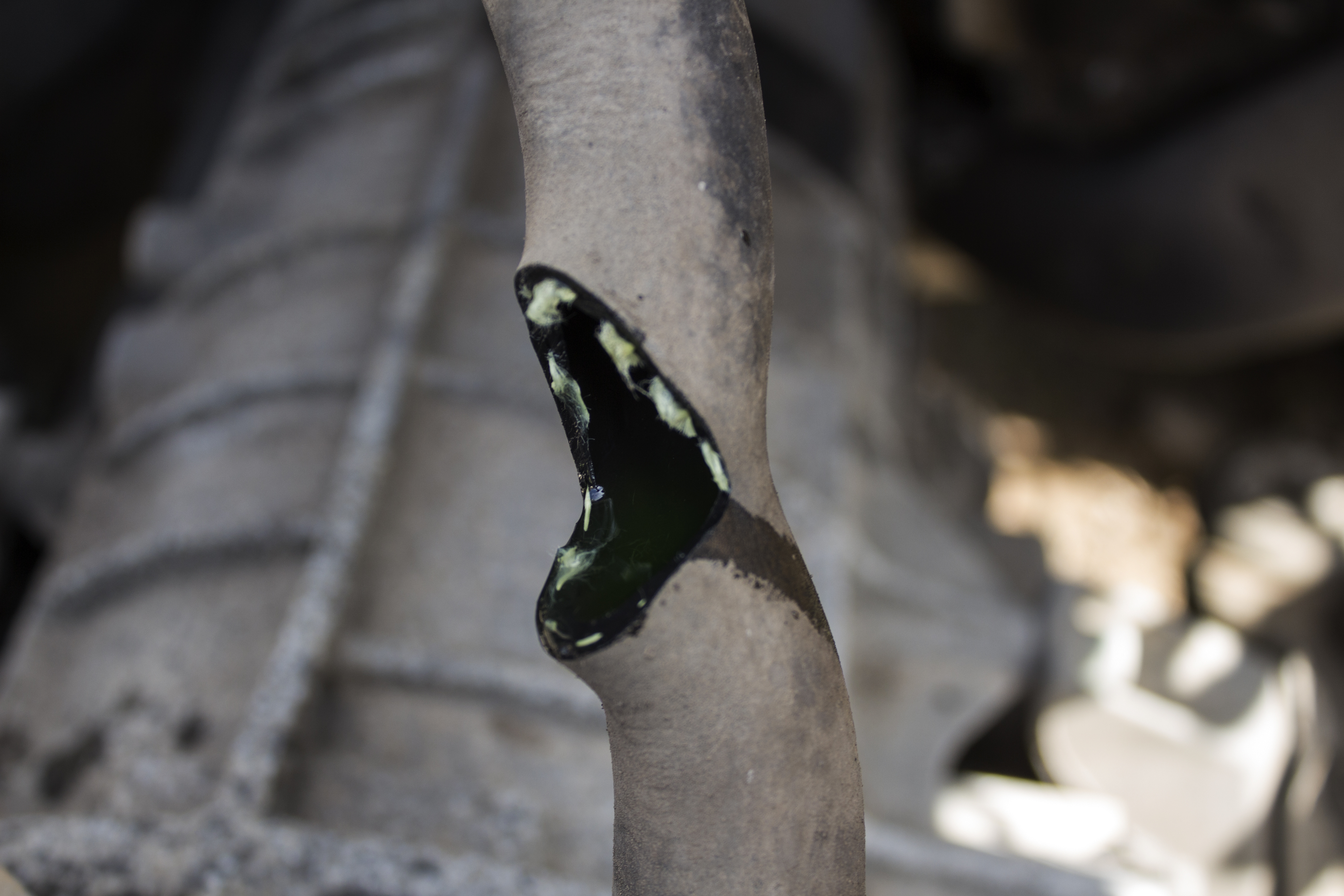
The high-pressure hose runs through a congested engine bay where it can contact belts, brackets, and other moving components. Abrasion damage is one of the earliest signs of impending failure and often appears well before the hose actually leaks.
Physical damage to look for includes cuts or abrasions in the outer jacket, fraying or separation of the reinforcement layer visible through the jacket, kinking or collapse of the hose wall from improper routing, and heat-related stiffening or cracking on sections near exhaust components. Because the hose operates under pressure, even superficial jacket damage warrants replacement. The reinforcement layer is the last line of defense against a blowout.
How Can You Tell If an AC High-Pressure Hose Is Leaking?
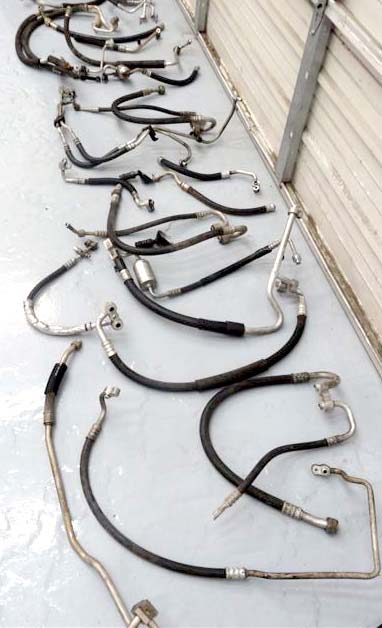
Refrigerant inside the high-pressure line runs at elevated pressure, so a small breach in the hose or its fittings will release refrigerant rapidly. Unlike an oil leak, refrigerant evaporates quickly, but it leaves behind traces that make leaks identifiable.
Look for oily residue along the hose body or at the fitting connections. Refrigerant carries a small amount of compressor oil through the system, and this oil deposits wherever a leak occurs. An Ultraviolet (UV) dye leak test is the most reliable diagnostic method: inject UV dye into the system, run the AC, and inspect with a UV lamp. Fitting leaks are common at both the compressor-end and receiver/drier-end connections and should be inspected along with the hose body. A hose that has begun leaking will lose refrigerant charge quickly, so address it promptly.
Why Does a Failing AC Hose Cause the System to Stop Cooling?

A complete loss of cooling is usually the final symptom of high-pressure hose failure, following physical degradation or a refrigerant leak that was not caught earlier. The AC system requires a minimum refrigerant charge to function. Once the charge drops below that threshold, the low-pressure cutout switch shuts the compressor off to protect it from running dry.
When the compressor shuts down, no refrigerant circulates, and the system produces only ambient air. The result is identical whether the root cause is a slow leak, a burst hose, or a fitting that has separated. If the AC stops cooling without a prior mechanical event, check the refrigerant charge before condemning the compressor or other components. A depleted charge from hose failure is a common misdiagnosis point.
Royal Brass & Hose has produced a video series on repairing AC hose assemblies that covers the replacement process step by step.
Need Help Selecting an AC Hose?
If an AC high-pressure hose is showing any of these signs, prompt diagnosis and replacement will prevent a costlier repair down the line. Royal Brass & Hose carries AC hose assemblies and fittings for a wide range of vehicle applications.
Contact us today or call us at 800-669-9650 for help selecting the right AC hose assembly for your application. We have 11 locations across the Southeast and Midwest, including Knoxville, TN; Marietta, GA; Orlando, FL; Charlotte, NC; Little Rock, AR; Fort Worth, TX; Benton, IL; Madisonville, KY; Princeton, WV; Birmingham, AL; and Calvert City, KY.
Frequently Asked Questions
Most AC high-pressure hoses have a service life of 10 to 15 years under normal conditions. Heat cycling, vibration, and contact with other components accelerate wear, so hoses on older vehicles or those with poorly routed lines may fail sooner. Inspect the hose visually whenever the vehicle is in for AC service.
The vehicle will still operate but continued driving with a leaking hose will drain the refrigerant charge and may allow moisture to enter the system. Moisture in the AC circuit damages the compressor and the desiccant in the receiver/drier. Repair the hose promptly.
Modern AC systems use R-134a or R-1234yf refrigerant. Both are non-toxic at typical leak concentrations in open air, but refrigerant released in an enclosed space can displace oxygen. Avoid running the engine in a closed garage if a significant leak is suspected.
Splice kits exist for some hose types, but splicing a high-pressure line is not recommended for automotive AC applications. The pressure and temperature cycling make spliced connections a reliability risk. Full hose replacement is the correct repair.
The high-pressure line carries refrigerant as a liquid from the compressor outlet to the condenser and receiver/drier, typically at 150 to 300 psi. The low-pressure line carries refrigerant as a vapor from the evaporator back to the compressor, at 25 to 45 psi. The two hoses differ in construction and are not interchangeable.


