

Key Takeaways
-
Guessing hydraulic thread sizes causes wrong fittings, wasted material, and avoidable freight costs.
-
Calipers that measure both inside diameter (ID) and outside diameter (OD) give you the data needed for accurate thread identification.
-
Thread identification (thread ID) kits with calibrated gauges for pipe, Unified National (UN), metric, and British Standard Pipe (BSP) threads eliminate guesswork.
-
Accurate measurements protect customer loyalty. Technicians and procurement teams depend on your getting it right the first time.
-
Gates offers thread ID kits and digital calipers for both North American and metric/BSP applications.
The phrase "measure twice, cut once" holds in every trade, but in hydraulic fitting work the stakes are concrete: wrong thread identification means wrong fittings, remade hose assemblies, return freight charges, and extended downtime for the customer. Five minutes with a caliper and a thread identification kit prevents hours of rework. There is no reliable shortcut through visual estimation.
Why Should You Always Measure Hydraulic Fittings with Calipers?
Visual thread identification, using what experienced technicians sometimes call the "calibrated eyeball", is not a method. Thread pitch, outside diameter, and port type all need to be confirmed with instruments. Five concrete reasons explain why:
1. Wasted Time
Incorrect fitting identification wastes time for both the customer and the employee. Sourcing a replacement after ordering the wrong fitting doubles the time to get equipment back in service.
2. Wasted Material
Wrong fittings mean wasted hose, fittings, pumps, and tools. Material costs accumulate quickly when assemblies must be remade.
3. Extra Expense
Freight and payroll costs compound with each mistake. Shipping the wrong fitting back and the correct fitting out adds direct, avoidable cost.
4. More Downtime
Every hour a machine waits for the correct fitting is lost productivity. In agriculture, construction, and industrial applications, downtime costs far exceed the price of a proper thread ID kit.
5. Customer Loyalty
Customers depend on technical accuracy when their equipment is down. Repeated identification errors erode confidence and drive them to competitors.
What Thread ID Tools Do You Need?
Accurate thread identification requires calipers that measure both the inside diameter (ID) and outside diameter (OD) of the fitting. Thread ID kits go further, providing calibrated gauges for multiple thread families in a single kit. Manufacturer resources from Brennan, Adaptall, and Gates provide additional reference guides for thread identification.
Three tools available from Royal Brass & Hose:
-
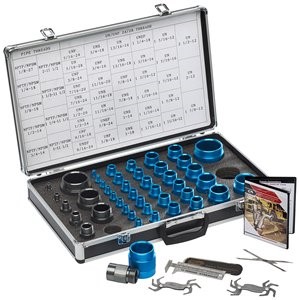
Gates Thread ID Kit: North American (Model 7369-0016): 45 anodized gauges covering pipe and UN/UNF threads.
-
Gates Thread ID Kit: Metric & BSP (Model 7369-0015): Male and female gauges for metric and British Standard Pipe (BSP) threads.
-
Digital Caliper (Model 7369-0322): LCD display with carrying case for field and shop use.
Need help?
Contact us today or call us at 800-669-9650 for help selecting thread ID kits and measurement tools for your location.
We have 11 locations across the Southeast and Midwest, including Knoxville, TN; Marietta, GA; Orlando, FL; Charlotte, NC; Little Rock, AR; Fort Worth, TX; Benton, IL; Madisonville, KY; Princeton, WV; Birmingham, AL; and Calvert City, KY.
Frequently Asked Questions
Thread pitch and outside diameter differences between common thread types are often less than a millimeter. Metric, BSP, and UN/UNF threads share enough visual similarity at a glance that accurate identification requires physical measurement. The consequences of a wrong call are a failed assembly or a blowout.
You need the outside diameter (OD) of the male thread and the thread pitch (threads per inch or threads per millimeter). For ports, you also need the inside diameter (ID) of the female port. A caliper handles OD and ID; a thread pitch gauge or thread ID kit confirms pitch and thread family.
The North American kit (7369-0016) covers pipe and UN/UNF threads with 45 anodized gauges. The Metric & BSP kit (7369-0015) covers male and female metric and British Standard Pipe (BSP) thread forms. Together they address the majority of hydraulic fitting thread types in North American and global equipment.
A mismatched thread will either fail to engage properly or cross-thread and damage the port. At operating pressure, a fitting that appears hand-tight but is not correctly threaded will leak or blow off entirely. At minimum, this means a rebuilt assembly; at worst, a pressure-related injury and damaged equipment.
If your shop services imported equipment, European machinery, or any system with BSP ports, yes. North American equipment predominately uses UN/UNF and pipe threads, but BSP fittings appear on imported excavators, loaders, and agricultural equipment. Carrying both kits covers the full range.
Accurate thread identification protects your shop's time, materials, and reputation. The right measurement tools pay for themselves after a single prevented mistake.


