

Key Takeaways
-
A PTO driveline telescopes as the implement moves. Too long and it bottoms out when the implement is raised, putting lateral stress on the tractor’s output bearing and the gearbox input. Too short and it loses the tube overlap needed to transmit torque, and risks separating under load. Both failures are preventable with the correct cut.
-
Cut equal amounts from both the inner and outer tube. Removing more from one side shifts the balance of the assembled shaft and introduces vibration at operating RPM.
-
For tube-in-tube shafts, at least one-third of the fully extended shaft length must remain as overlap at maximum extension. Slip sleeve shafts use a different standard: the slip sleeve must be fully covered on the extended side. Always confirm the spec for your model before cutting.
-
Cut the plastic guard tubes to match their corresponding shaft tubes, then verify that each profile tube extends 40mm (1.58”) beyond the guard tube end after reassembly. A guard that overhangs the tube end creates a pinch point and interference with surrounding components.
-
Deburr all cut ends before reassembly. Metal shavings that enter the shaft during operation accelerate wear on seals and the cross-and-bearing assembly.
-
Grease the sliding profiles before reassembly. Before operating, run three final checks: minimum engagement in the lowered position, smooth telescoping through the full range of motion, and guards rotating freely on the yokes.
A Power Take-Off (PTO) shaft set to the wrong length does real damage before the season is out. One cut too long will bottom out when the tractor raises the implement, putting lateral stress on the output shaft and gearbox. One cut too short loses the tube overlap needed to transmit torque reliably and risks separating under load. Getting the length right is a straightforward shop task, but the procedure has to be followed correctly. Most problems come from cutting unequal amounts from each half or skipping the minimum engagement check after the cut.
Why Is PTO Shaft Length Critical?
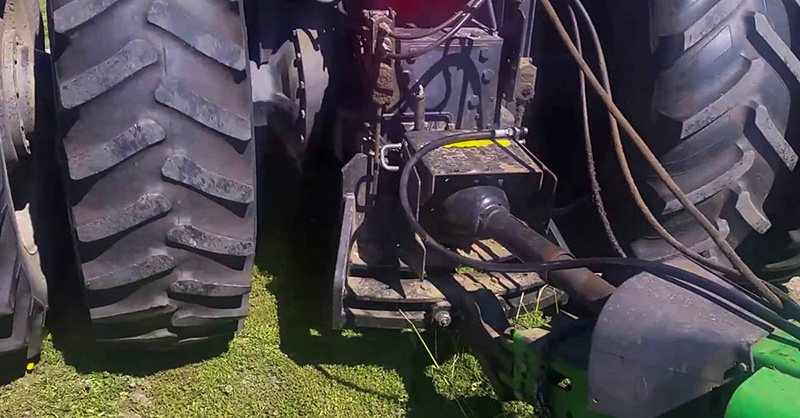
A PTO driveline telescopes as the implement moves through its range of motion. In operating position, the shaft is extended. When lifted for transport or headland turns, it compresses. If the collapsed length is longer than the distance between the tractor and implement connection points, the shaft bottoms out and the tubes bear the full load of the lift, which they are not designed to handle. Repeated bottoming damages the tractor's output bearing and the implement's gearbox input. At the other extreme, a shaft with insufficient tube overlap under full extension can separate from the implement mid-operation.
How Do You Measure the Correct PTO Shaft Length?
Before cutting, take these measurements with the implement connected and in its lowest operating position:
-
Fully collapse the driveline by pushing the inner and outer tubes together.
-
Measure the overlap: the length where the two tubes are nested together.
-
Subtract the required minimum engagement from the overlap. For a standard tube-in-tube shaft, the rule of thumb is that one-third of the fully extended shaft length must remain as overlap at maximum extension. For shafts with a slip sleeve rather than nested tubes, minimum engagement means the slip sleeve is fully covered on the extended side. Confirm the specification for your model before cutting.
-
The remaining figure is the total safe cutting allowance. Divide it equally between the two halves. That is the maximum you can remove from each end.
-
If the overlap is already at or near minimum engagement in the fully collapsed position, the shaft may not need to be cut at all.
How Do You Cut a PTO Shaft?
Weasler’s procedure calls for cutting equal amounts from each half of the driveline. This is the correct approach when both inner tubes are the same length, which is the case on most standard shafts. If one tube is longer than the other, equal cuts will not produce equal results; measure each tube individually and calculate the cut for each independently. Cutting more from one side than the other shifts weight distribution and can introduce vibration at operating speed.
-
Mark both the inner and outer tubes at the cut line. Include the plastic guard tubes in your measurements.
-
Cut both tubes and both guard tubes at the marked lines using a metal cutting saw or angle grinder with a cutoff wheel.
-
Deburr all cut ends thoroughly with a file or deburring tool. Do not skip this step. Metal burrs and shavings will work into the shaft during operation and accelerate wear on seals and the cross-and-bearing assembly.
-
Wipe down all cut surfaces with a clean rag before reassembling.
-
Grease the sliding profiles before reassembly. Use the grease type specified for your shaft model. Dry sliding surfaces accelerate wear on the inner and outer tube profiles.
-
Reassemble the guard halves. Both profile tubes should extend 40mm (1.58”) beyond the end of the guard tubes once reassembled. A guard tube that overhangs the profile tube end creates a pinch point and interference with surrounding components.
-
Reconnect the shaft and run three checks before operating: verify minimum engagement in the fully lowered position, confirm the shaft telescopes smoothly through its full range of motion, and confirm the guards rotate freely on the yokes.
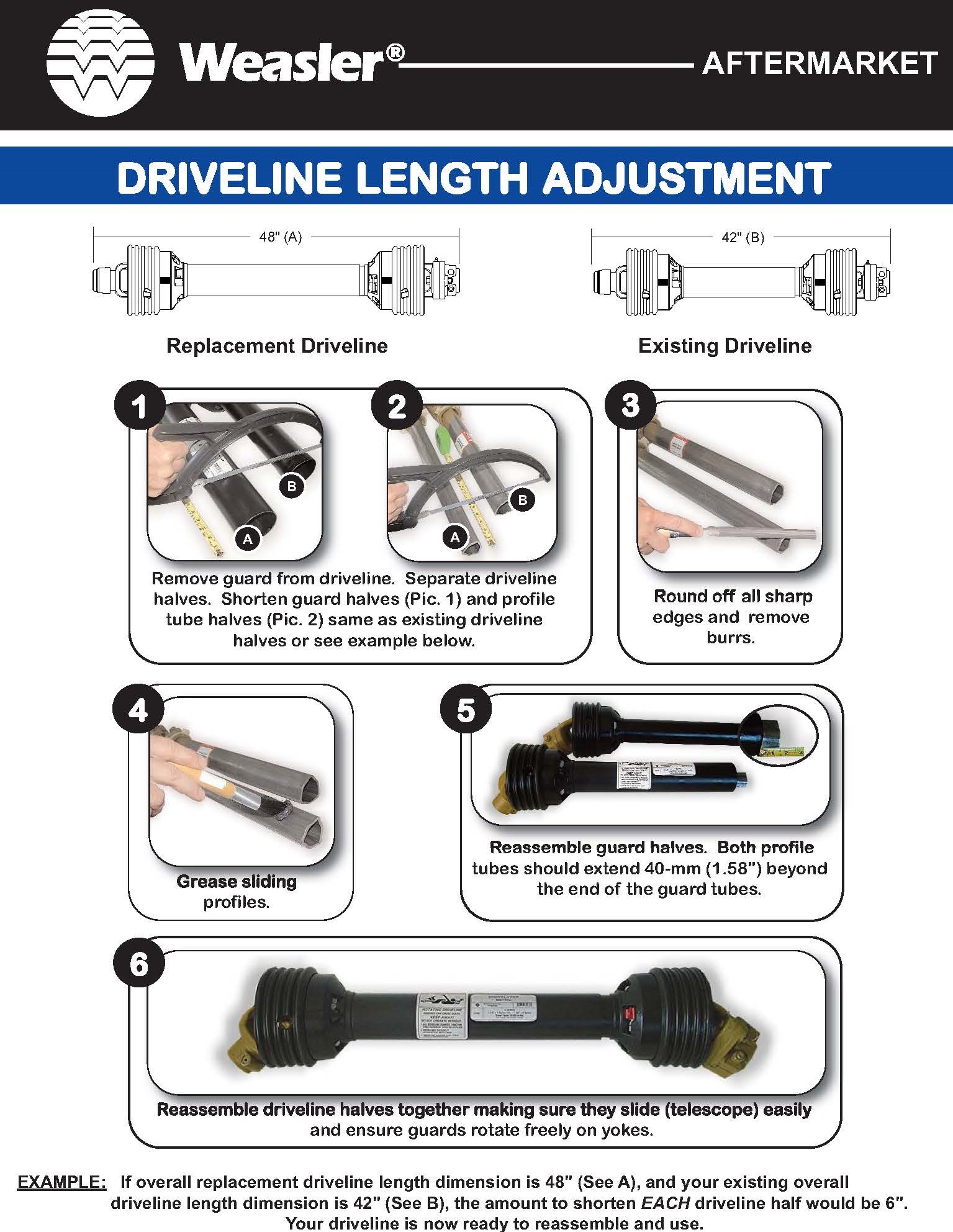
For a visual walkthrough of this process, watch the Weasler driveline length adjustment video.
What Tools Do You Need to Cut a PTO Shaft?
The cut requires only standard shop tools:
-
Tape measure
-
Marker or scratch awl
-
Metal-cutting saw (hacksaw, reciprocating saw, or angle grinder with a cutoff wheel)
-
File or deburring tool
-
Clean shop rag
If the inner tube is a non-round profile, such as hex or star-shaped, confirm your cutting tool can handle the geometry before starting. An angle grinder with a standard cutoff wheel handles any tube profile without issue.
Royal Brass and Hose stocks driveline assemblies and driveline components from Weasler and other leading manufacturers.
Need Help?
Royal Brass and Hose stocks Weasler driveline assemblies, components, and replacement parts. If you need help selecting a replacement shaft or sourcing the right length for your equipment, our team can help you get the right fit before the season starts.
Contact us today or call us at 800-669-9650 for help with driveline length selection or replacement parts. We have 11 locations across the Southeast and Midwest, including Knoxville, TN; Marietta, GA; Orlando, FL; Charlotte, NC; Little Rock, AR; Fort Worth, TX; Benton, IL; Madisonville, KY; Princeton, WV; Birmingham, AL; and Calvert City, KY.
Frequently Asked Questions
No. Always cut equal amounts from both the inner and outer tube. Removing material from only one side changes the balance of the assembled shaft and can introduce vibration at operating RPM. The Weasler cutting procedure specifies equal cuts on both halves for this reason.
The general rule for tube-in-tube shafts is one-third of the fully extended shaft length as minimum overlap. For slip sleeve designs, minimum engagement means the slip sleeve is fully covered at full extension. Six inches is a rough reference point for typical shaft lengths, but check the specification sheet for your specific model before cutting. Operating below minimum engagement risks the tubes separating under torque load.
Yes. The plastic guard tubes must be trimmed to match the metal tubes they cover. A guard that extends past the end of its tube creates a pinch point and can interfere with implement or tractor components during operation.
A shaft cut below minimum engagement cannot safely transmit full torque. Under load, the tubes may slip or separate. If too much material has been removed, the shaft needs to be replaced rather than repaired.
Only if the tube profile is round. Many PTO inner tubes are hexagonal or splined. A standard pipe cutter cannot handle those profiles. Use a metal cutting saw or an angle grinder with a cutoff wheel for reliable results on any tube geometry.


